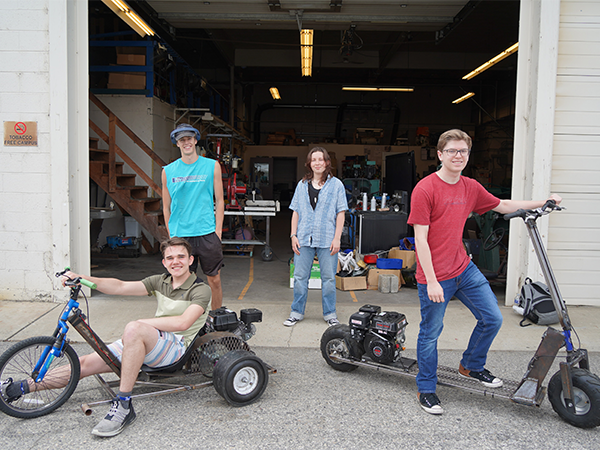
Meet Wenatchee Valley College’s Mechatronics Club. Drop in on one of this club’s weekly meetings, and you may well find everyone with their welding helmet down as sparks fly from a tig welder. Regardless of what the club is up to, they like projects that get their hands dirty and help them build practical skills. One club member stated, "We are more than the sum of our parts." Sharing knowledge and working together are important characteristics of the Mechatronic Club.
The Mechatronic Club is a place for students to use and develop their mechanical, electrical, and computer skills to get experience designing and prototyping. By default, the club’s mission includes an intersection of knowledge areas and skill sets, such as computer-aided design, digital control systems, and electro-mechanics. Club members learn by doing, and Mechatronics is open to all interested students regardless of how much experience they have. WVC industrial technology professor Zack Jacobson serves as the club's advisor.
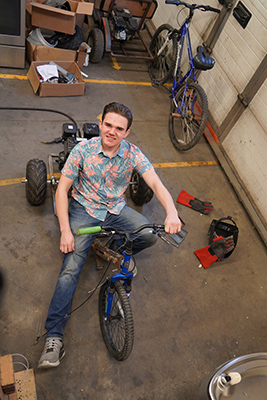 At the end of 2025, most of the Mechatronics members had graduated, leaving Cash Fowler as
one of two members left. Using some playful peer pressure, Cash recruited a few friends
to join, including WVC students Van Ostrom and Owen Tveten. Soon thereafter, Lucy Korzh saw
a Mechatronics poster around campus and, having wanted to find a STEM-related club
to join, she was in, too: “I wanted to participate in something that's actually related
to the field I want to go into.” All Mechatronics Club members this year were Running
Start students from local high schools in the Wenatchee Valley.
At the end of 2025, most of the Mechatronics members had graduated, leaving Cash Fowler as
one of two members left. Using some playful peer pressure, Cash recruited a few friends
to join, including WVC students Van Ostrom and Owen Tveten. Soon thereafter, Lucy Korzh saw
a Mechatronics poster around campus and, having wanted to find a STEM-related club
to join, she was in, too: “I wanted to participate in something that's actually related
to the field I want to go into.” All Mechatronics Club members this year were Running
Start students from local high schools in the Wenatchee Valley.
This club’s activities appeal to students with an interest in electronics, engineering, mechanics, and technology design projects. The key ingredient is having persistent curiosity about how things work—tinkering. At the beginning of this past academic year, the club focused on remote control airplanes but found that they required a lot of specialized knowledge and money to get in the air. Then, at the WVC Student Club Expo in the fall, the club brought one of its go-karts, which sparked an idea. “Roberto Villa [in Student Life] said, ‘It'd be really cool to show this off in the Apple Blossom [parade]’, and I thought ‘that's a great idea,’ for each one of us to work on our own vehicle,” Cash recalls.
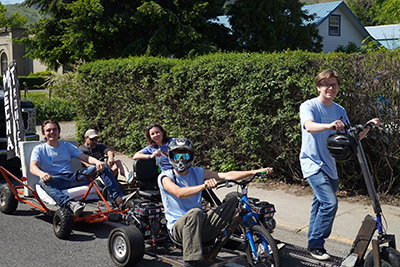 The idea to build go-karts took root thanks to several factors. The club had access
to scrap metal, and as an official student club, their budget allowed them to purchase reliable parts,
like the steel for the frame, the motors, and the wheels. Some club members had built
go-karts before, so the project allowed them to teach their peers welding, woodworking, and
metalworking skills. After working on their go-karts for several months, the Mechatronics
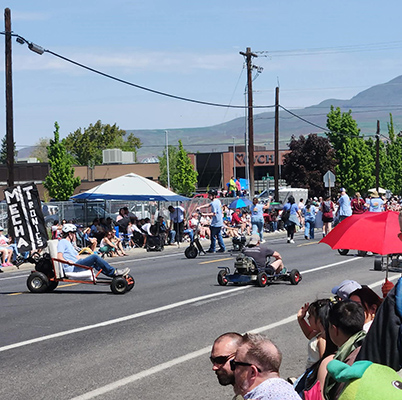
Club debuted their “Frankenstein” karts at the 2026 Apple Blossom Stemilt Grand Parade.
Professor Jacobson joined Cash, Van, Lucy, and Owen in driving the go-karts through
the entire parade route. “All of the club members have been transfer students this
year. These students were unlikely to set foot in a shop environment, use power tools,
plasma cutters, welders, or ever have the opportunity to construct machines of this
nature. Only at WVC! I am very proud of this crew and what they’ve built,” Zack shared.
Club members were thrilled the go-karts made it through the entire route and added
how their favorite memory was driving back to campus down ninth street as a group
after the parade ended.
The idea to build go-karts took root thanks to several factors. The club had access
to scrap metal, and as an official student club, their budget allowed them to purchase reliable parts,
like the steel for the frame, the motors, and the wheels. Some club members had built
go-karts before, so the project allowed them to teach their peers welding, woodworking, and
metalworking skills. After working on their go-karts for several months, the Mechatronics
Club debuted their “Frankenstein” karts at the 2026 Apple Blossom Stemilt Grand Parade.
Professor Jacobson joined Cash, Van, Lucy, and Owen in driving the go-karts through
the entire parade route. “All of the club members have been transfer students this
year. These students were unlikely to set foot in a shop environment, use power tools,
plasma cutters, welders, or ever have the opportunity to construct machines of this
nature. Only at WVC! I am very proud of this crew and what they’ve built,” Zack shared.
Club members were thrilled the go-karts made it through the entire route and added
how their favorite memory was driving back to campus down ninth street as a group
after the parade ended.
As club president, Cash not only found a club that aligned with his interests, he also found an opportunity to practice his leadership skills. For example, he encouraged the club from the start to take on more coordinated projects that involved working as a team: “I really wanted to have a group [where everyone] is working towards the same goal,” Cash said. He also shared his knowledge of power tools with his peers and really enjoyed that. “I do want to keep teaching people. I think that’s something I really enjoyed… Teaching others has also kind of taught me a lot of things about working together in the Mechatronics Club,” he said. For Cash, building a go-kart was the vehicle for cooperative learning that he had hoped for since the project helped him learn skills from his peers. Cash plans to transfer to the University of Washington, where he will continue to seek out ways to develop his leadership and teaching skills, perhaps in conjunction with his plan to study electrical engineering.
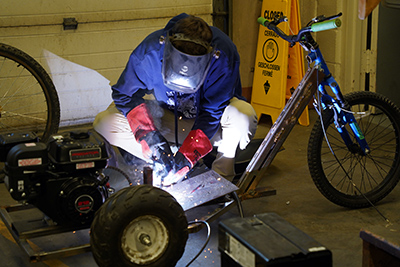 Looking back, club members view their time in Mechatronics positively. Owen really liked
getting the club’s first remote control airplane flying, “especially since we had
a lot of failed attempts beforehand,” he recalls. For some, Mechatronics served as
an introduction to welding: “Oh yeah, I was really scared of it…there were sparks
flying everywhere! After I figured it out, it was a lot more enjoyable, just putting
together random pieces of scrap from [the bins],” Lucy reflected.
Looking back, club members view their time in Mechatronics positively. Owen really liked
getting the club’s first remote control airplane flying, “especially since we had
a lot of failed attempts beforehand,” he recalls. For some, Mechatronics served as
an introduction to welding: “Oh yeah, I was really scared of it…there were sparks
flying everywhere! After I figured it out, it was a lot more enjoyable, just putting
together random pieces of scrap from [the bins],” Lucy reflected.
The club is grateful to Professor Jacobson for being their fearless advisor. “He’s done so much for us, you know¾stayed late, allowed us to do [all this]…Yeah, without Zack, we definitely would not be doing this,” Cash offered. Lucy highlighted Zack’s eagerness to go above and beyond: “Zack put in so much more effort than just having his name as the advisor.”
Having just graduated from their high schools and from WVC this June, these budding engineers and designers are excited about what lies ahead for each of them. Cash and Van will attend the University of Washington to study electrical engineering and mechanical engineering respectively, and Lucy will be moving to the Bay Area this fall to study electrical engineering and computer science at UC Berkeley. Owen is planning on serving a two-year mission for his church in South America.
 These club members also hold hope that Mechatronics will continue as a WVC club and
acknowledge that the club activities will likely evolve, just as they did when they joined. When
asked about their hopes for the future of the Mechatronics Club, this year’s members expressed
optimism about passing the torch but expect that the next iteration of Mechatronics
will do different things than they have, just as the focus of the club has changed
each year up till now. Lucy emphasized that it's nice to see the finished result of
a project after all of the hard work that goes into it, and suggests that future club
members will get out of the club what they put into it. Cash also pointed to the importance
of leadership, advising next year’s club to “find someone who’s a good leader, [that]
likes to teach and help.”
These club members also hold hope that Mechatronics will continue as a WVC club and
acknowledge that the club activities will likely evolve, just as they did when they joined. When
asked about their hopes for the future of the Mechatronics Club, this year’s members expressed
optimism about passing the torch but expect that the next iteration of Mechatronics
will do different things than they have, just as the focus of the club has changed
each year up till now. Lucy emphasized that it's nice to see the finished result of
a project after all of the hard work that goes into it, and suggests that future club
members will get out of the club what they put into it. Cash also pointed to the importance
of leadership, advising next year’s club to “find someone who’s a good leader, [that]
likes to teach and help.”
Visit the college’s website to learn more about the Mechatronics Club and Industrial Technology programs.