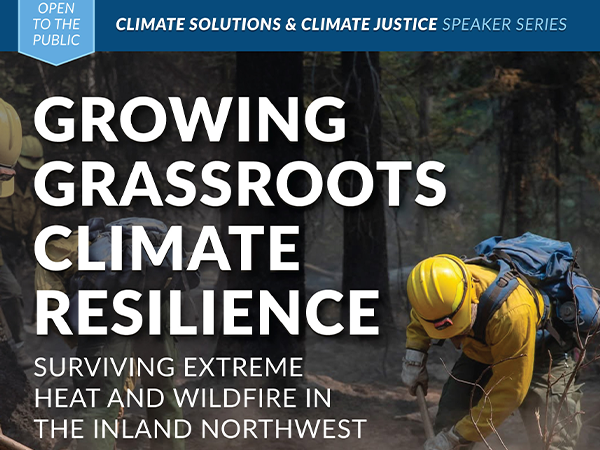
The WVC Sustainability Committee and English Department, in partnership with Sustainable NCW and CAFE, are hosting a public lecture, “Growing Grassroots Climate Resilience: Surviving Extreme Heat and Wildfire in the Inland Northwest,” with WVC alum Dante Jester. This free lecture will be held on Wednesday, Oct. 14, with doors opening at 6 p.m. in the Grove Recital Hall on the Wenatchee campus.
Jester is the Climate Resilience Program manager at Gonzaga University's Institute for Climate, Water, and the Environment. In this lecture, Jester will discuss climate resiliency work being done in Spokane and relate the extreme heat and wildfire issues in Spokane to similar issues in the Wenatchee Valley. They will explain how local community buildings can serve as resilience hubs before, during, and after climate events; how Spokane is creating and implementing a cooperative climate resilience plan co-written by 30+ local organizations; how to gather and utilize community-engaged research to drive community-invested change; and ideas for building neighborhood leader networks.
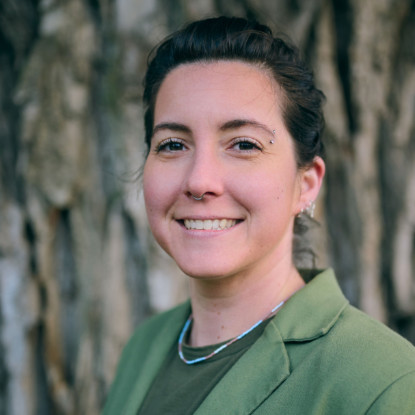 Jester has a B.A. in Peace Studies, Master of Science in Climate Change and Development,
and Professional Certificate in Climate Action Planning. They are a registered Adaptation
Practitioner with the Climate Smart Communities Initiative and a certified electric
coach through Rewiring America. Born and raised in Orondo, their commitment to climate
justice stems from their experiences growing up as close neighbors with migrant farmworkers,
working in Peace Corps Paraguay, and researching drought impacts in small-scale agroforestry
systems. Their areas of expertise are in extreme heat and wildfire smoke resilience
with a focus on developing resilience hubs with libraries and community centers, facilitating
neighborhood resilience workshops, building cross-organization collaboration, and
exploring the role of academia in community climate resiliency. Having grown up in
the orchards of the Wenatchee Valley, Jester’s experiences with the risks of wildfires
and smoke inform much of who they are and how they do their work.
Jester has a B.A. in Peace Studies, Master of Science in Climate Change and Development,
and Professional Certificate in Climate Action Planning. They are a registered Adaptation
Practitioner with the Climate Smart Communities Initiative and a certified electric
coach through Rewiring America. Born and raised in Orondo, their commitment to climate
justice stems from their experiences growing up as close neighbors with migrant farmworkers,
working in Peace Corps Paraguay, and researching drought impacts in small-scale agroforestry
systems. Their areas of expertise are in extreme heat and wildfire smoke resilience
with a focus on developing resilience hubs with libraries and community centers, facilitating
neighborhood resilience workshops, building cross-organization collaboration, and
exploring the role of academia in community climate resiliency. Having grown up in
the orchards of the Wenatchee Valley, Jester’s experiences with the risks of wildfires
and smoke inform much of who they are and how they do their work.
This event is part of the WVC Climate Solutions and Climate Justice Speaker Series. For more information about WVC’s sustainability efforts, visit www.wvc.edu/sustainability
About Wenatchee Valley College
Founded in 1939, Wenatchee Valley College enriches North Central Washington and delivers relevant, innovative, and experiential educational opportunities for thriving and healthy communities. Learn more at www.wvc.edu.
Equal Opportunity Statement
Wenatchee Valley College is committed to a policy of equal opportunity in employment and student enrollment. All programs are free from discrimination and harassment against any person because of race, creed, color, national or ethnic origin, sex, sexual orientation, gender identity or expression, the presence of any sensory, mental, or physical disability, or the use of a service animal by a person with a disability, age, parental status or families with children, marital status, religion, genetic information, honorably discharged veteran or military status or any other prohibited basis per RCW 49.60.030, 040 and other federal and state laws and regulations, or participation in the complaint process. Learn more at www.wvc.edu/publicdisclosure.
Published Oct. 1, 2026
Media Contacts:
Dr. Joan Qazi, Sustainability Coordinator, jqazi@wvc.edu
Marcine Miller, Executive Director, Public Information Office, 509-682-6582, mmiller2@wvc.edu
Yesenia Perez, Environmental Justice Coordinator, CAFE, yesenia.perez@wenatcheecafe.org