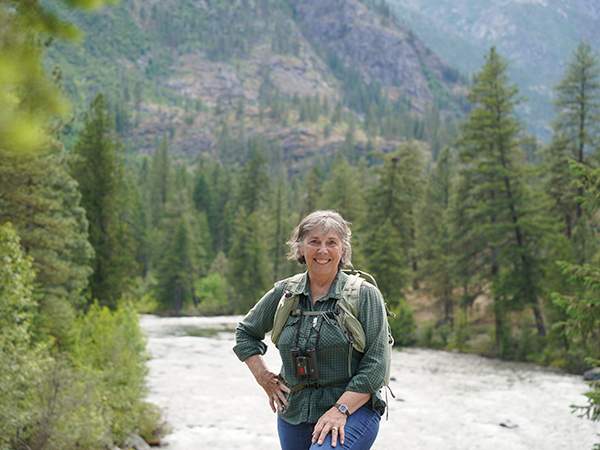
Meet Heather Wallis Murphy. Heather has dedicated her life to nature conservation through her work as a wildlife biologist, nature writer, artist, and community leader. She credits her experience at Wenatchee Valley College (WVC) with helping her discover a gift for the arts while launching her career in wildlife biology in North Central Washington.
Heather’s journey at WVC began in 1975 when she enrolled in the forest technology program after studying for three years at Washington State University (WSU) and the University of Washington (UW). “I moved to Wenatchee from a remote town in Yakima County called Ahtanum. I had just quit my first job with the Department of Natural Resources (DNR), and I was applying for Forest Service jobs. I decided to keep working on my education and started taking forestry classes at Wenatchee Valley College. I just loved it,” Heather shared.
Ecology was an emerging academic field in the 1970s, and Heather credits WVC Professors Phil Unterschuetz and Wade Boyd with helping advance her studies and learn about fire ecology for the first time. “Phil Unterschuetz was a forest ecologist; he was so forward-thinking, I couldn’t believe how advanced the college was,” Heather said. “Wade Boyd came from the timber industry, and his expertise was in forest management, the measuring of trees, layout of roads, and design of road systems. I was exposed to technical drawing for the first time. That was exciting for me.”
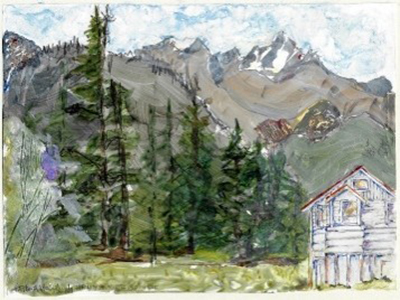 After studying at UW and WSU, Heather quickly noticed the benefits of studying ecology
and dendrology, the study of trees, in the Wenatchee Valley. “At WSU, our study sites didn’t include
a lot of Western Washington species. And again, at UW, we would see trees at the Arboretum
in Seattle, but we didn’t have the subalpine larch or the Western larch. At WVC, our
classes went out in the field to the native forest, where we could reach 13 species
of conifers. We’re in the transition between Western and Eastern Washington, so we
have the arid shrub steppe and the wet mesic forest (a type of forested wetland); they
come together right here, and the professors took advantage of that. We didn’t have
a college arboretum because we have it right in our backyard,” she shared.
After studying at UW and WSU, Heather quickly noticed the benefits of studying ecology
and dendrology, the study of trees, in the Wenatchee Valley. “At WSU, our study sites didn’t include
a lot of Western Washington species. And again, at UW, we would see trees at the Arboretum
in Seattle, but we didn’t have the subalpine larch or the Western larch. At WVC, our
classes went out in the field to the native forest, where we could reach 13 species
of conifers. We’re in the transition between Western and Eastern Washington, so we
have the arid shrub steppe and the wet mesic forest (a type of forested wetland); they
come together right here, and the professors took advantage of that. We didn’t have
a college arboretum because we have it right in our backyard,” she shared.
During college and after graduating, Heather continued to work seasonal jobs with the forest service. Some of her favorite memories center around becoming friends with the people she met in her classes at WVC and running into her classmates at ranger stations throughout Washington during different stages of their careers. Heather also described the challenges she faced as a woman trying to get a full-time job in a male-dominated field in the 1970s. “It took me three years before I got a paid full-time job. I remember going into the DNR’s main office and chatting with the team. Then about twenty-five years later, unbeknownst to me, a woman I’d met in that office back in 1974 told me that I inspired her to pursue her forestry degree. She went to the University of Idaho and said that just knowing I could do it made her feel like she could do it too,” Heather recalled.
Heather’s first Forest Service job was as a one-month biological technician in 1975 with the Spruce Budworm survey project, counting egg masses at the biology lab at Wenatchee Valley College. Heather next joined the Soil Conservation Service in 1976, now known as the Natural Resources Conservation Service. During the spring of that year, Squilchuck State Park hosted an environmental camp for local schools, bringing natural science agencies together to teach students. Heather represented the Soil Conservation Service and taught students about the importance of soil as the basis of ecology. She met other working groups, learned about other field jobs to apply for, and was eventually offered a summer job with the Forest Service.
“I worked for the Leavenworth Ranger District cruising trees, walking up and down the hillside, and learning about the natural ecosystem of this land,” she shared. A fellow student from Wenatchee Valley College worked on her crew, and Heather fondly remembers the discussions they would have in the field. “It was a really good time because we didn’t get put down for thinking differently. We were asked to think critically at WVC, and we had so many questions because we wanted to do the right thing,” she said.
Heather moved on to work for the Chelan Ranger District. In the late ‘70s, she supervised her first crew in reforestation, working with them on both sides of Lake Chelan to rehabilitate the landscape after the 1970 fires. The Lake Wenatchee Ranger District called Heather to lead a 16-person crew called the Young Adult Conservation Corps. Heather would stay at Lake Wenatchee and the Wenatchee River Ranger District for the next 27 years of her career, working in wilderness management, range management, cultural resources management, and her goal, wildlife management. As her career progressed, she began to see connections forming between her education and her experience in the field. “I love to learn, but I sometimes wondered why I was in these classes, like soil science classes, then I got a job in soil management. It could feel disconnected, but then it all came together!” Heather added.
When asked where art came into her life, Heather shared with a laugh, “That is definitely Wenatchee Valley College’s fault! I always doodled — birds, flowers, trees, and houses — when I was a kid. I took jewelry making and weaving in high school, instead of drawing, because I’m the youngest of five sisters and they’re all super talented. I didn’t want to compete with them, so I just went my own way.” At WSU, she took an art class as a prerequisite and remembers a professor told her not to go into art and to stay in science. “The professor told me I didn’t have what it takes to be an artist, so I went, okay, that’s what I think, too. No big deal,” Heather said.
However, a few years later at WVC, Heather needed to take another art class in order to graduate with her forestry degree. “I took Darrell Dietrich’s art class. He had us do blind contour drawings where we used the right side of our brain instead of the left. I would draw my fellow students, and my drawings looked like them! I wondered where did that come from? I was doing a lot of technical drawings for a science class, that was another part of my upbringing as an artist,” she said. When Heather graduated, Professor Dietrich asked her not to stop making art. “It was the opposite of my earlier experience. He knew I was going to go to UW to get my bachelor's degree in wildlife biology, and he wrote me a letter of reference to the art department to ask for a science person to join the arts program. And they let me in!”
Heather began keeping field journals in 1974 while she was working seasonal jobs as a student. “I would write down the day’s work, what I would observe, or notes I would pass on, sometimes I would add a little sketch. Like, where’s that campsite in relationship to the stream,” she described. Her field journals continued over the years as Heather became a wildlife biologist for the Forest Service. “In 1992, my artist sister Barbara Kerwin sent me a blank journal without lines, a watercolor set, and a watercolor brush I’ve since destroyed. She said, ‘it’s time for you to add color to your drawings.’”
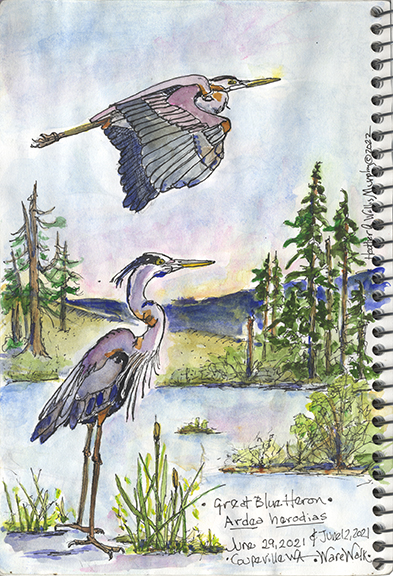 Five years later in 1997, Heather’s watercolor sketch of a tree filled with birds was
accepted into her first art show thanks to the encouragement of her friend Gretchen
Daiber. “It was nerve-wracking putting my stuff in front of other people,” Heather
recalled. Her friendships serendipitously helped her launch her card business. “My
friend Patti Bosket arranged flowers for the show; another friend gave one of the
bouquets to me. So, I painted that bouquet, color copied it on cardstock, cut it down
to fit into an envelope, and sent my friends thank you cards.” Soon after a friend
showed the handmade card to the Sleeping Lady Mountain Resort, the marketing director
called Heather to express interest in selling her cards. “I thought, I don’t even
know what you’re talking about! I’m a Forest Service person, but I went down there
with my journals. Sleeping Lady selected images, then test marketed the cards, and
sold out within the first month!”
Five years later in 1997, Heather’s watercolor sketch of a tree filled with birds was
accepted into her first art show thanks to the encouragement of her friend Gretchen
Daiber. “It was nerve-wracking putting my stuff in front of other people,” Heather
recalled. Her friendships serendipitously helped her launch her card business. “My
friend Patti Bosket arranged flowers for the show; another friend gave one of the
bouquets to me. So, I painted that bouquet, color copied it on cardstock, cut it down
to fit into an envelope, and sent my friends thank you cards.” Soon after a friend
showed the handmade card to the Sleeping Lady Mountain Resort, the marketing director
called Heather to express interest in selling her cards. “I thought, I don’t even
know what you’re talking about! I’m a Forest Service person, but I went down there
with my journals. Sleeping Lady selected images, then test marketed the cards, and
sold out within the first month!”
Her card business quickly took on a life of its own. Soon, local businesses in Leavenworth like A Book for All Seasons, Home Fires Bakery, and Mailboxes Etc. began to carry her cards. “I got my business license, hired card representatives, and applied to sell my work at the national parks. That was the first time I had to learn about business and work-life balance, since I was still a full-time wildlife biologist,” Heather said. Heather would transition into the life of a full-time artist sooner than she expected.
In 1994, the Northwest Forest Plan was established to address threats to endangered species on federally managed lands in Washington, Oregon, and California. Wildlife biologists were heavily involved in improving conditions in our national forests and federal lands. “We had to conduct surveys, learn how to manage our land better, do ecosystem management and [move to] watershed-based instead of creek-based,” Heather said. “It was very big picture, and I honed into wildlife biology.” Nearly a decade later, the U.S. Forest Service was recognized as part of the Smithsonian Institute’s 39th Folklife Festival in 2005. Heather went to Washington D.C. to represent the Forest Service with 100 employees to tell the agency’s story as a wildlife biologist. “That was the apex of my career,” Heather added. “On my days off, I went to the bird lab at the Smithsonian and looked at the early explorer’s specimens from the West. Then, I drew them in my field journal and studied the birds. I had no idea I would be retiring soon, because I loved what I was doing so much. I loved working with the crew and the progressive work we were doing on the Forest.” However, that same year, as part of the Bush administration’s efforts to reduce federal spending, the Forest Service offered buyouts of permanent employees working on federal lands. Heather decided to take an early retirement and invested the buyout into her card business.
The importance of community is a running theme throughout Heather’s journey from studying at WVC to the present day. From helping found the Leavenworth Spring Bird Fest and Salmon Fest, to her involvement with Team Naturaleza!, an organization that connects Latine communities in North Central Washington to birdwatching and the great outdoors, to organizing Last Tuesday Artists group in Leavenworth, Heather believes in creating opportunities for everyone to experience the wonder of nature.
To this day, Heather continues to volunteer for the forest service and uses her skills as a wildlife biologist to help our community. “The Upper Basin Birders go out once a month to do field studies that were started for ecosystem management. We go back to where our field crews were before we did any timber management or recreation development. We’re still gathering data in eBird; this keeps my field biology going,” she shared.
Reflecting on her connection to North Central Washington, Heather said, “This place chose me. When I was in college, I wanted to work in the Tetons of Wyoming or Acadia in Maine. I wanted to be a National Park person, but instead, because of my life situation, I moved to Wenatchee and fell in love with the diversity of habitats here.”
Art has opened Heather’s life to new possibilities that are uniquely intertwined with her career as a wildlife biologist. A local artist, Claire Sianna Seaman, encouraged Heather to join her in applying for an artist-in-residence program with Olympic National Park that invites artists to document the melting glaciers. “When I got into the artist-in-residence program with Olympic National Park, I thought this is where I wanted to go. I had no clue I’d ever get to work with the National Parks, through art, I always thought it would be through science!” Heather said.
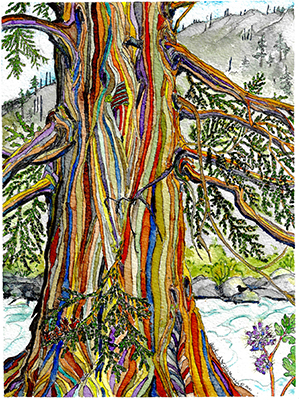 This spring, Heather returned to her WVC roots and submitted work to the college’s
literary and arts journal, Mirror Northwest. Several of her paintings and sketchbooks
were featured in the 2026 edition. “It was so serendipitous,” she shared. During the
launch party, Heather walked in just as a student began to read a poem in Spanish,
with Heather's piece Stripey: Western Red Cedar projected on the screen. “It brought tears to my eyes! It was better than I ever
thought, and it probably wasn’t planned that way at all, but it made me feel so good!”
This spring, Heather returned to her WVC roots and submitted work to the college’s
literary and arts journal, Mirror Northwest. Several of her paintings and sketchbooks
were featured in the 2026 edition. “It was so serendipitous,” she shared. During the
launch party, Heather walked in just as a student began to read a poem in Spanish,
with Heather's piece Stripey: Western Red Cedar projected on the screen. “It brought tears to my eyes! It was better than I ever
thought, and it probably wasn’t planned that way at all, but it made me feel so good!”
Heather encourages students to go after their dreams: “Follow your heart and you will reach your goals eventually. Just like doing these field surveys over and over again, you just keep walking ahead, and in the long run you’ll get there, put it all together, and it makes so much beautiful sense. But when you’re doing it, you feel like you’ll never make it. Don’t give up on your dreams – just keep walking your path.”
Visit wildtales.com to view Heather’s art.